Dimensions
- Overall Length
- Overall Width
- Overall height
- Wheelbase
- Road Clearance
- Seat height
- Dry weight
Engine
- Type
- Cooling sys.
- Bore & Stroke
- Displacement
- Compression
- Max HP
- Max Torque
- Carbs
ZX900
- 86.6 inches 2,200 mm
- 29.5 inches 750 mm
- 47.8 inches 1,215 mm
- 58.9 inches 1,495 mm
- 5.5 inches 140 mm
- 30.7 inches 780 mm
- 502 lbs 228 kg
ZX900
- 4 cylinder four stroke
- Liquid-cooled
- 72.5 x 55.0 mm
- 908 cc
- 11.0 to 1
- 115 @ 9,500 rpm
- 62.9 @ 8,500 rpm
- 4 Keihin CVK34
2000 ZX-7R
- Overall Length 84.7 in.
- Overall width 29.1 in.
- Overall height 44.5 in.
- Wheelbase 56.5 in.
- Ground clearance 4.1 in.
- Seat height 33.1 in.
- Dry weight 448 lbs.
We
have attached a dimension comparison to a Y2K sport bike. Now this should turns
out quite surprising. The 15 year old Ninja is still does not differ from a
modern sport bike by more than 3 inches. In some dimensions it is even better.
It has a lower seat height by almost 4 inches, yet the ground clearance is a
inch and a half greater. Now that will have less stuff dragging in the twisties.
Also it keeps the center of gravity of the rider lower. It has a wheelbase that
is only 2.4 inches longer. Now this can easily be adjusted by shortening the
swing arm but in all but the most flickable turns this difference is negligible.
Weight is a big gap, but it is not difficult to pare 50 to 60 lbs off of a stock
900 Ninja. These are the main reasons we decided to resurrect a 1985 ZX900-R
as our first project bike. We have no illusions that today's sportbike is on
a plane than this vintage sportbike but we are curious as to how close we can
come without spending the price of a 2K bike. Now be forewarned much of what
we do to the bike is not found at the parts counter. Also trick parts we fabricate
are one off items. But we will try to keep it to a level that a enthusiast with
a good degree of mechanical aptitude can reproduce.
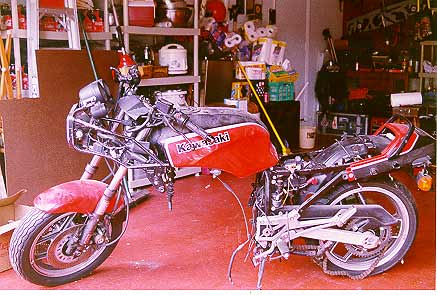
To
the left the project bike. We already pulled it apart, but the condition is
still clearly visible. The tank is dented one side cover is cracked. The upper
fairing is salvageable but the center is pretty bad. The fender is cracked.
We are debating about refurbishing the plastics on hand or trying to track down
used pieces in good enough condition for paint. The frame and associated metal
hardware is in good shape.
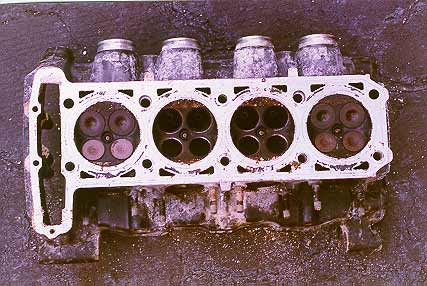
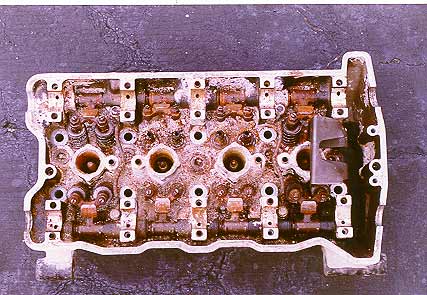
The
cylinder head was not a pretty sight. We couldn't figure out how the water got
in there. Fortunately the water did not get down into the cylinders or the bottom
end. We were in luck though an had another head with only a pair of bent valves.
So we stole a couple out of this head, cleaned them up and save our selves a
ton of money. Hopefully your project bike does not have such damage. When it
rains in Florida it does pour. Some how 15 years of summer storms caused this.
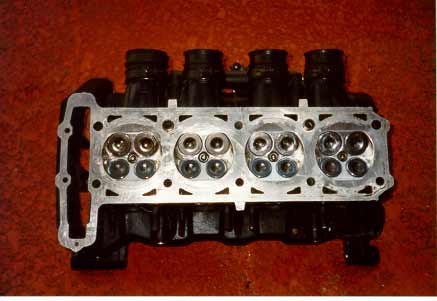
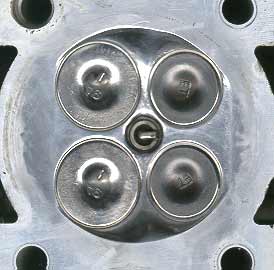
While
our fix was cheap it was labor intensive. The bent valves were replaced and
then the head was cc 'd and leak tested. Then all irregularities and casting
flaws were ground out. Finally all of the combustion chambers were highly polished.
CC-ing a head involves taking a graduated syringe and measuring how much fluid
it takes to fill each combustion chamber. Then you remove material from each
head until they all match the one with the greatest volume. Leak checking is
done by filling each combustion chamber with light oil and seeing if any leaks
away over a period of 24 hours. This head is ready to go back on the motor.
Polishing the combustion chambers helps reflect heat. You also polish the piston
domes. Reflected heat helps ignite the fresh fuel and aids in a more even burn.
Also the polished surfaces shed deposits easier and less combustion heat is
picked up by the metal of the engine, thus resulting in a cooler running motor.
The exhaust gasses will be hotter though so those of you with chrome pipes will
have a greater incidence of chrome discoloration..

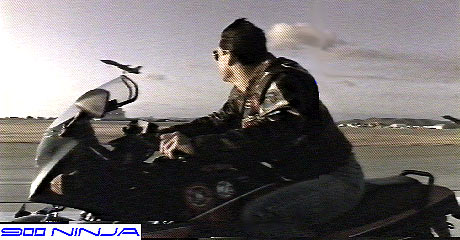
The 900 Ninja's claim to fame
is highlighted in the photo above. In 1984 it was a radical departure
from the traditional motorcycle look and boasted the latest technological
gadgets. It wore a 16 inch wheel out front with adjustable air or nitrogen
preload forks adjustable damping and hydraulic anti-dive. The rear has
a cam design chain tensioner, monoshock air/nitrogen dampening adjustable
suspension. The swingarm was box tubular aluminum and a 18 inch rear wheel.
The engine was also brand new.
Water cooled and the size and weight of a 750 motor. Kawasaki moved the
cam chain from the middle of the crank to the left end and moved the alternator
to above the cases and behind the cylinders. On top dual overhead cams
actuated easy to adjust rocker arms that helped keep the height of the
engine low. A plain bearing single piece crank rounded out the motors
features. Carburetion was supplied by four 34 mm flat slide Keihin CV
carbs. The Chassis was a over the engine triangulated steel frame utilizing
the engine as a stressed frame member. The motorcycle had a detachable
rear subframe. Wow now doesn't all that sound very familiar. It should
it is the basis around which almost all modern sportbikes are built.
The final result was a bike
that was a full bore 900 but the size and weight of most 750's of the
time. So the next time you admire all of the modern technology on your
new sport scoot. Take time an remember that in 1984 most of that first
saw the street on this motorcycle. Next up the bikes vital statistics.
Even by toady's standards this motor is no slouch. In the hands of a expert
rider it could embarrass a less adept rider on much more modern machinery.